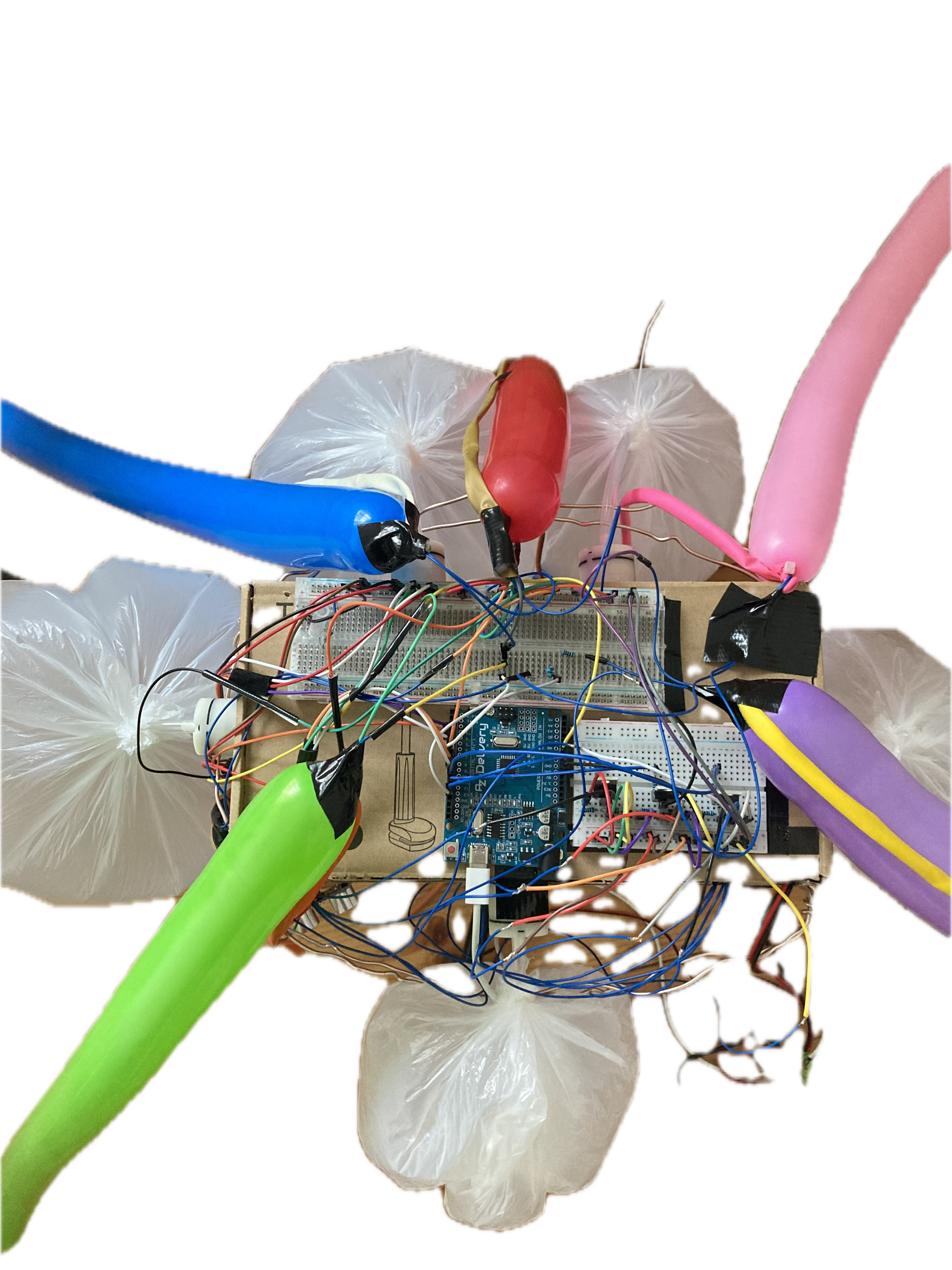
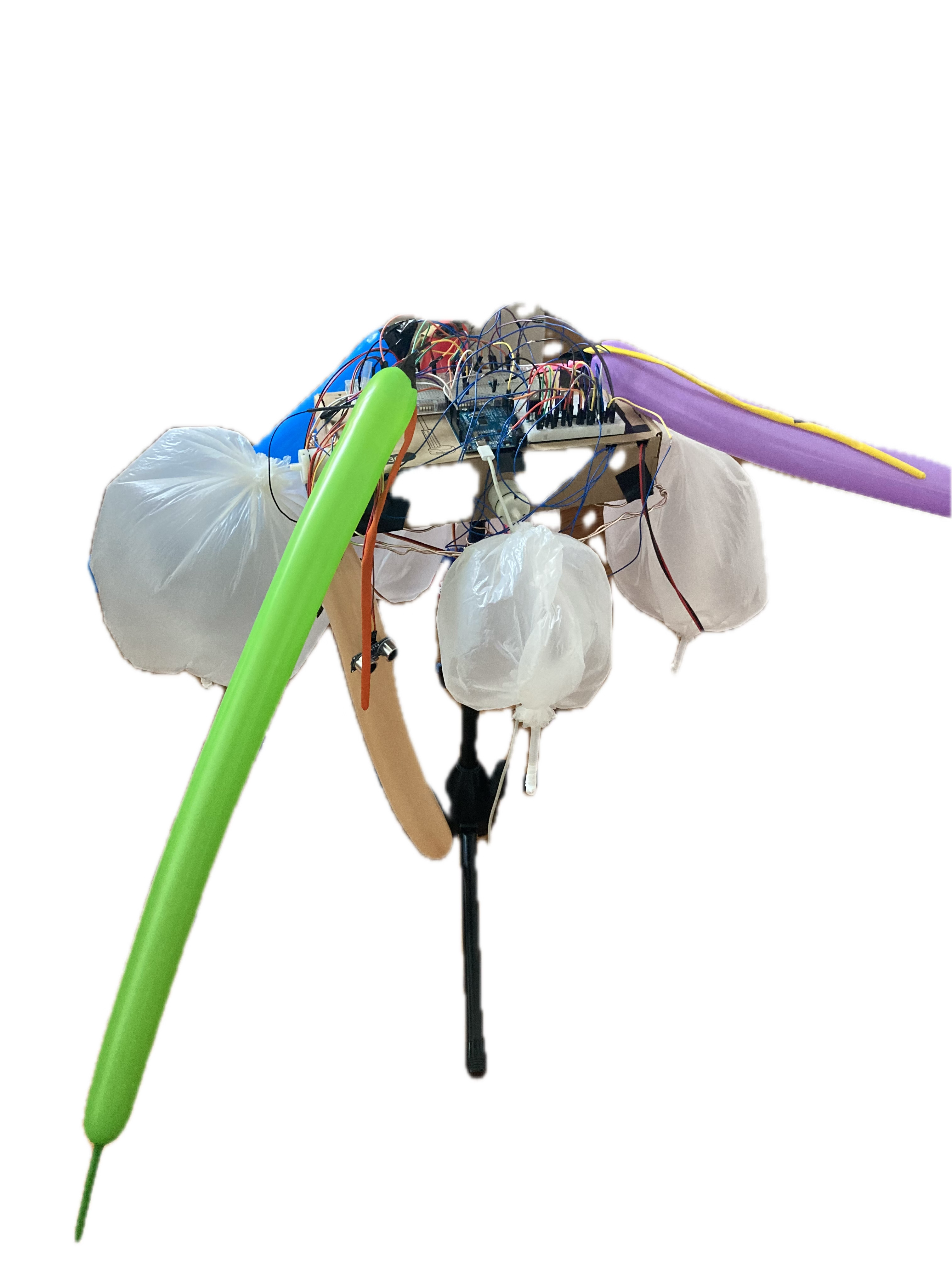
MUT [2025] is an interactive installation that operates at the threshold between machine and organism. The work presents a body that does not imitate life, yet insists on being perceived as alive. What traces can evoke life? The sculpture is activated by the proximity of a viewer, responding with involuntary spasms, contractions and regular pulses. Movement emerges as a form of resistance — hesitant, fragmented, and unstable. Its structure consists of a semi-transparent membrane inhabited by silicone tentacles, flexible wires, and inflatable elements. These components are set into motion by small motors and air-driven mechanisms, producing shifting, non-repetitive patterns. The internal system remains partially exposed, emphasizing a fragile, constructed corporeality rather than a seamless illusion of life. Subtle LED flickering reinforces this unstable vitality. Contact microphones capture friction and micro-movements within the material, amplifying an otherwise inaudible internal activity. What becomes audible is not a voice, but a body under stress — contracting, stretching, and oscillating between movement and stillness. The installation is governed by a microcontroller-based system that continuously processes environmental input. A combination of infrared and ultrasonic sensors detects proximity and distance, triggering threshold-based behaviours and stochastic timing processes. This results in a quasi-autonomous system that never repeats itself, yet never fully stabilizes. MUT stages a liminal condition between life and non-life, agency and automatism. It invites the viewer into an ambiguous encounter: the presence of a body that reacts, but does not communicate; that moves, but does not act; that seems to live, yet remains irreducibly artificial.